A brewery tap list is the menu of beers a taproom is pouring right now, usually showing each beer’s name, style, alcohol content and sometimes its bitterness and color. Knowing how to read a brewery tap list turns a chalkboard full of numbers and odd words into an easy choice, whether you are at your neighborhood taproom or stopping in somewhere new on a New Mexico road trip.
Here is what the three common numbers mean, what the style words are telling you, and how pour sizes work, from a flight of samples to a can to take home.
The three numbers: ABV, IBU and SRM
Most tap lists show at least one number beside each beer, and many show three. Each one answers a different question: how strong is it, how bitter is it, and how dark is it? The typical ranges below come from the Beer Judge Certification Program (BJCP), the group that writes the style guidelines used to judge beer competitions.
ABV: how strong it is
ABV stands for alcohol by volume, the share of the beer that is alcohol. It is the most useful number on the board, because it tells you how big a beer is before you order a full glass. For a sense of scale:
- Light lager: about 2.8% to 4.2% ABV
- American IPA: about 5.5% to 7.5% ABV
- Imperial stout: about 8% to 12% ABV
That is a wide spread. A 10% beer carries more than twice the alcohol of a 4.5% beer in the same size glass, which is why stronger beers are often poured in smaller glasses.
IBU: how bitter it is, roughly
IBU stands for International Bitterness Units, a lab measure of the bitter compounds hops add to beer. According to the Craft Beer & Brewing dictionary entry on bitterness units, one IBU equals one milligram per liter of iso-alpha acid, the main bittering compound from hops. A light lager sits around 8 to 12 IBU, an American IPA around 40 to 70, and a double IPA can reach 100.
Treat IBU as a hint, not a promise. The same entry notes that malt sweetness can cover bitterness, so a rich, strong beer with a high IBU can taste less bitter than a lean, dry beer with a lower one.
SRM: how dark it is
SRM stands for Standard Reference Method, a scale for beer color. The American Homebrewers Association explains that the American Society of Brewing Chemists developed it in 1950, and that it runs from pale straw at 1 SRM to nearly black at 40 and above. Color comes mostly from the malt. A light lager is 2 to 3 SRM, an American IPA 6 to 14, and an imperial stout 30 to 40.
Color tells you about roast, not strength. A pale beer can be strong, and a dark beer can be light-bodied and easy to drink.
Common style words on a beer menu
After the numbers, the words in a beer’s name or style line do most of the talking. These show up on taproom boards across New Mexico.
- Hazy. A cloudy IPA with lots of juicy, fruity hop flavor and softer bitterness. The BJCP’s Hazy IPA guidelines put it at 6% to 9% ABV and 25 to 60 IBU, a lower bitterness range than a classic IPA.
- West Coast. The clear, dry, firmly bitter side of the IPA family. The BJCP calls West Coast IPA a type of American IPA rather than a separate style.
- Session. A lower-alcohol beer built for a relaxed pace. The American Homebrewers Association cites a working definition of under 5% ABV.
- Imperial or double. A bigger, stronger version of a base style. A double IPA runs about 7.5% to 10% ABV, and an imperial stout 8% to 12%.
- Nitro. A beer served with a gas blend that is mostly nitrogen instead of the usual carbon dioxide. A Craft Beer & Brewing dictionary entry describes the result: tiny bubbles, a dense and lasting creamy head, and a smoother, softer feel.
- Barrel-aged. A beer rested in wooden barrels, often ones that held bourbon, whiskey or wine. The BJCP’s wood-aged beer guidelines note that barrels can add vanilla, caramel or toast notes plus character from what the barrel held before. These beers often run stronger than average.
- Sour. A tart beer, with the tang usually coming from lactic acid rather than hops. A classic example, Berliner weisse, is a pale, refreshing wheat beer at just 2.8% to 3.8% ABV. Fruit is a common addition.
Words stack, too. A “hazy double IPA” is a cloudy, juicy IPA brewed strong, and a “barrel-aged imperial stout” is a strong dark beer with barrel character on top. Read them left to right and you can usually picture the beer before it arrives.
Pour sizes: flights, pints, crowlers and growlers
The last column on many tap lists is price by size. Here is what each size usually means.
Flights
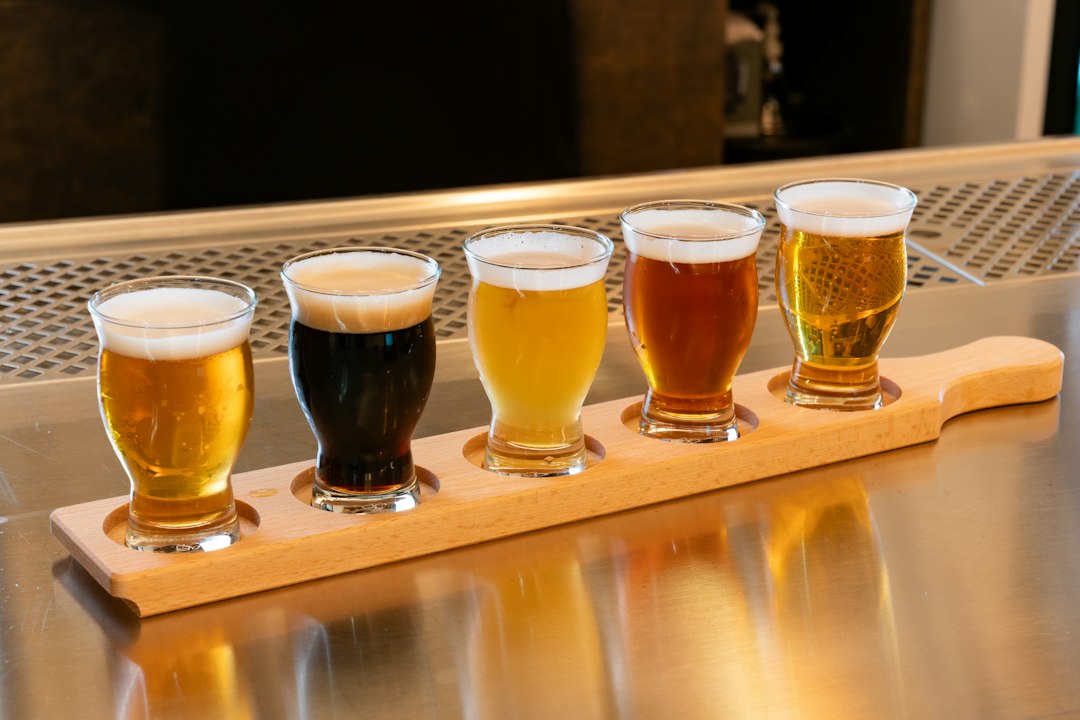
A flight is a set of small tasting pours served together, often on a wooden paddle, so you can try several beers without committing to a full glass of any of them. It is the friendliest way to start at a new brewery. Order across styles, say a lager, an IPA and something dark, and taste from lightest to darkest so the bigger beers do not drown out the delicate ones.
Many New Mexico taprooms offer them. In Santa Fe, Tumbleroot Brewery and Distillery makes its beers and spirits from scratch, and its own website invites visitors to try a flight of either. Ask the bartender what is pouring. Most are happy to help you build a flight.
Pints and smaller glasses
A pint is the standard full pour, and a U.S. pint is 16 ounces. Glass sizes vary from taproom to taproom, though, and strong beers like imperial stouts or barrel-aged releases are often served in a smaller glass. If the board lists ounces, that is the number to go by.
Crowlers and growlers
These are the to-go sizes. According to Untappd’s guide to crowlers and growlers, a crowler is a 32-ounce aluminum can filled from the tap and sealed on the spot, a format developed by Oskar Blues Brewery with can maker Ball. A growler is a refillable jug, usually glass or stainless steel, that holds 64 ounces or more. A crowler is single-use and recyclable, while a growler is one you bring back to refill. Either way, keep it cold and drink it soon after it is filled.
Fill options differ by brewery, so check before you go if you want to take something home.
Tap list FAQ
What does IBU mean on a beer menu?
IBU stands for International Bitterness Units, a measure of the bitter compounds hops add to beer. Higher numbers generally mean more bitterness: a light lager might be around 10 IBU and an IPA 40 to 70. Malt sweetness can soften how bitter a beer tastes, so use IBU as a rough guide.
What is the difference between hazy and West Coast IPA?
A hazy IPA is cloudy, soft and juicy, with less bitterness. A West Coast IPA is clear, dry and more bitter. Both are IPAs; they just show off hops in different ways.
Is a crowler bigger than a growler?
No. A crowler is a 32-ounce can, and a growler usually holds 64 ounces or more. The crowler is sealed and single-use, and the growler is refillable.
What should a beginner order first?
A flight. A few small pours across different styles will tell you more about your own taste than any menu can, and the bartender can point you toward the house favorites.
Put the tap list to work
Next time you face a full board, glance at the ABV, read the style words left to right, and start with a flight. The New Mexico taprooms section of New Mexico Breweries lists places to try it statewide, from Farmington to Las Cruces. Pace yourself, and plan a designated driver or a ride home.