Santa Fe Brewing Company sells a West Coast IPA called 7K. The name is not a hop variety or a batch number. It is the elevation of the brewery: 7,168 feet above sea level, which the brewery puts on the can as a point of pride.
That is the useful thing to understand about brewing at altitude in New Mexico. It is not a quirk that a few mountain breweries deal with. Almost every brewery in the state works a mile or more above sea level, and thin air changes the physics of the brewhouse in ways a brewer has to plan around. Here is what actually changes, and what turns out not to matter as much as you would think.
Water boils cooler up here
This is the root of everything else. Water boils when its vapor pressure matches the air pressure pushing down on it. Less air overhead means less pressure to overcome, so the boil arrives at a lower temperature.
The standard figure is a drop of about 6 degrees Fahrenheit for every 3,200 feet of elevation. Run New Mexico’s brewing towns through that and the spread is real:
- Sea level: 212 °F
- Albuquerque, roughly 5,300 feet: about 202 °F
- Santa Fe, about 7,200 feet: about 199 °F
- Red River, 8,750 feet: about 196 °F
A full rolling boil in Red River is sixteen degrees cooler than the same rolling boil in San Diego. The kettle looks identical. The chemistry inside it is not.
What brewing at altitude actually changes: hop bitterness
Hops do not arrive in the kettle bitter. The alpha acids in the cone have to be converted by heat into the compounds that taste bitter, a reaction called isomerization. That reaction is temperature-sensitive, and a cooler boil runs it less efficiently.
The numbers are not trivial. Treating sea level as the baseline, hop utilization falls to roughly 56 percent at 200 °F. Published guidance for brewers at 6,500 feet is that they need something like 44 percent more hops than a sea-level brewer to land on the same bitterness.
Homebrewers often use a correction factor developed by hops author Mark Garetz, which scales the bittering charge by elevation. It works out to about 1.19 in Albuquerque and about 1.26 in Santa Fe. In plain terms: an ounce of bittering hops in a sea-level recipe becomes roughly an ounce and a quarter at the Santa Fe altitude.
Here is the honest complication. Working brewers disagree about how much any of this matters in a glass. Garetz himself has written that the brewer usually cannot taste the bitterness difference. Another longtime voice in the homebrewing literature put it more bluntly, calling the adjustment hardly worth the effort. And the brewmaster at Backcountry Brewery in Frisco, Colorado, sitting above 9,000 feet, has argued that a genuinely vigorous boil covers most of the gap on its own.
Which is a good reminder that a spreadsheet and a palate are different instruments. The reaction really is slower up here. Whether a drinker notices depends on the recipe, the boil, and how hop-forward the beer was meant to be in the first place.
Thin air gives yeast less to work with
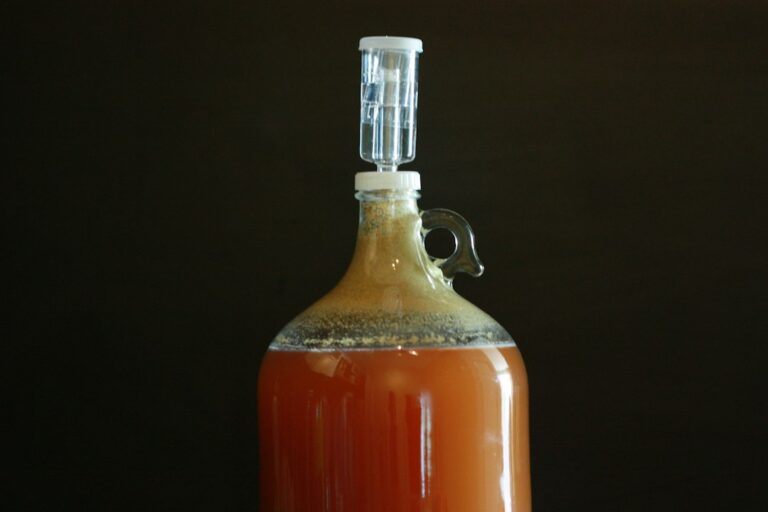
The second effect gets less attention and is arguably more consequential. Lower air pressure means less oxygen dissolves into the wort, and yeast needs dissolved oxygen early in fermentation to build healthy cell walls before it starts converting sugar to alcohol.
A sloppy aeration routine that produces acceptable beer at sea level has less margin at 7,000 feet. The fixes are straightforward once you know to apply them: oxygenate the wort more aggressively, or pitch more yeast. White Labs has suggested that some California ale strains handle elevation better than English strains, because they demand less oxygen to begin with.
This is the part that separates a brewery that has solved altitude from one that is still fighting it, and it is invisible from the taproom.
Carbonation math changes too
Carbonation is a pressure balance, so it moves with elevation as well. Ambient pressure falls by about half a pound per square inch for every 1,000 feet of climb, which means a brewer balancing a keg system has to add roughly 0.5 psi per 1,000 feet to the pressure a sea-level chart would give them.
For a taproom in Santa Fe, that is a correction of about three and a half psi. Skip it and the beer pours flatter than intended. It is a small number that shows up in every pour.
Does beer hit you harder at 7,000 feet?
Almost certainly not, and the research on this is more settled than the folklore suggests. The belief traces back to a Columbia University psychologist in the 1930s who claimed a few cocktails at 10,000 feet would act like twice as many. Later work has not supported him. An Austrian study gave young climbers the equivalent of a liter of beer near sea level and again at close to 10,000 feet, and their blood alcohol readings came out nearly the same in both places. A Federal Aviation Administration study of pilots in the late 1970s found that altitude and alcohol each hurt performance on their own, but found no significant interaction between the two.
What is likely going on is simpler. Thinner air can leave you mildly short on oxygen, and that lightheadedness is easy to file as intoxication. If you have just driven up from somewhere lower and you are still acclimating, that feeling has a cause other than the beer. Either way, the usual arrangement applies: pick a designated driver or a rideshare before the first pour, not after.
New Mexico’s range, bottom to top
Few states ask their brewers to cover this much vertical distance. Las Cruces breweries work at about 3,900 feet, which is already higher than almost anywhere outside the Mountain West. Albuquerque sits near 5,300. Santa Fe and Los Alamos are above 7,000. And Red River Brewery & Distillery, at 8,750 feet in the Sangre de Cristo range, is the highest brewery in the state and one of the highest-elevation distilleries anywhere.
That is a span of nearly 5,000 feet inside one state’s borders. A recipe that a brewer dials in at the Las Cruces altitude would need real adjustment to hit the same marks in Red River. Which makes the fact that New Mexico breweries keep bringing home national medals a little more impressive than the medal count alone suggests.
It also explains why Santa Fe Brewing Company put its elevation on a label in the first place. Brewing well at 7,168 feet is a thing worth naming.
What to do with this at the bar
Mostly, enjoy the beer. None of this is a flaw you need to taste around, and none of it is something a well-run brewery has not already accounted for. But it is a decent conversation starter, and it reframes a tap list a little. The IPA in your hand took more hops to get where it is than the same recipe would have taken on the coast.
If you want to see the range for yourself, the New Mexico brewery directory and map at New Mexico Breweries covers the whole state, from the low desert around Las Cruces to the mountain taprooms above 8,000 feet. Pick two at different elevations and make a weekend of it.